.NET Framework
This article is about the Microsoft technology. For the Top-level domain, see .net. For other uses, see .NET.
The Microsoft .NET Framework is a software framework for Microsoft Windows operating systems. It includes a large library, and it supports several programming languages which allows language interoperability (each language can utilize code written in other languages.) The .NET library is available to all the programming languages that .NET supports.
The framework's Base Class Library provides user interface, data access, database connectivity, cryptography, web application development, numeric algorithms, and network communications. The class library is used by programmers, who combine it with their own code to produce applications.
Programs written for the .NET Framework execute in a software (as contrasted to hardware) environment, known as the Common Language Runtime (CLR). The CLR is an application virtual machine so that programmers need not consider the capabilities of the specific CPU that will execute the program. The CLR also provides other important services such as security, memory management, and exception handling. The class library and the CLR together constitute the .NET Framework.
The .NET Framework is intended to be used by most new applications created for the Windows platform. In order to be able to develop and not just run applications, it is required to have Microsoft's SDK for Windows 7 or .NET Framework 4 (or newer) or Visual Studio 2010 installed on your computer.
Principal design features
Interoperability
Because computer systems commonly require interaction between new and older applications, the .NET Framework provides means to access functionality that is implemented in programs that execute outside the .NET environment. Access to COM components is provided in the System.Runtime.InteropServices and System.EnterpriseServices namespaces of the framework; access to other functionality is provided using the P/Invoke feature.
Common Runtime Engine
The Common Language Runtime (CLR) is the execution engine of the .NET Framework. All .NET programs execute under the supervision of the CLR, guaranteeing certain properties and behaviors in the areas of memory management, security, and exception handling.
Language Independence
The .NET Framework introduces a Common Type System, or CTS. The CTS specification defines all possible datatypes and programming constructs supported by the CLR and how they may or may not interact with each other conforming to the Common Language Infrastructure (CLI) specification. Because of this feature, the .NET Framework supports the exchange of types and object instances between libraries and applications written using any conforming .NET language.
Base Class Library
The Base Class Library (BCL), part of the Framework Class Library (FCL), is a library of functionality available to all languages using the .NET Framework. The BCL provides classes which encapsulate a number of common functions, including file reading and writing, graphic rendering, database interaction, XML document manipulation and so on.
Simplified Deployment
The .NET Framework includes design features and tools that help manage the installation of computer software to ensure that it does not interfere with previously installed software, and that it conforms to security requirements.
Security
The design is meant to address some of the vulnerabilities, such as buffer overflows, that have been exploited by malicious software. Additionally, .NET provides a common security model for all applications.
Portability
The design of the .NET Framework allows it to theoretically be platform agnostic, and thus cross-platform compatible. That is, a program written to use the framework should run without change on any type of system for which the framework is implemented. While Microsoft has never implemented the full framework on any system except Microsoft Windows, the framework is engineered to be platform agnostic,[2] and cross-platform implementations are available for other operating systems (see Silverlight and the Alternative implementations section below). Microsoft submitted the specifications for the Common Language Infrastructure (which includes the core class libraries, Common Type System, and the Common Intermediate Language),[3][4][5] the C# language,[6] and the C++/CLI language[7] to both ECMA and the ISO, making them available as open standards. This makes it possible for third parties to create compatible implementations of the framework and its languages on other platforms.
Architecture
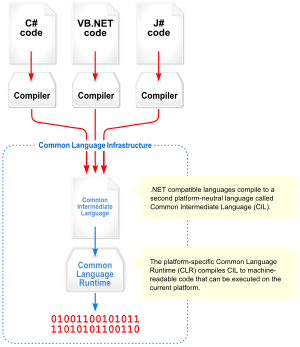

Common Language Infrastructure (CLI)
Main article: Common Language Infrastructure
The purpose of the Common Language Infrastructure (CLI), is to provide a language-neutral platform for application development and execution, including functions for exception handling, garbage collection, security, and interoperability. By implementing the core aspects of the .NET Framework within the scope of the CLI, this functionality will not be tied to a single language but will be available across the many languages supported by the framework. Microsoft's implementation of the CLI is called the Common Language Runtime, or CLR.